Here’s something that might surprise you: nearly one in three consumers skip Google entirely and start their searches on social media platforms instead. For Gen Z, that number jumps past 50%.
Social media SEO isn’t just a nice-to-have anymore.
It’s essential.
Your audience is searching for products, tutorials, reviews, and recommendations on TikTok, Instagram, YouTube, and LinkedIn before they ever touch a traditional search engine.
If your content isn’t optimized for these platforms, you’re invisible.
Let’s break down exactly how to optimize your content so people find it.
Key Takeaways
- Social platforms are now primary search engines: One in three consumers bypass Google, searching directly on TikTok, Instagram, and YouTube for product information and recommendations
- Keywords matter everywhere: Titles, captions, hooks, thumbnails, and on-screen text all need strategic keyword placement for platform algorithms to surface your content
- Engagement beats follower count: 1,000 engaged community members deliver more value than 10,000 passive followers, making authentic interaction critical for visibility
- Platform-specific optimization is required: Each social network has unique search algorithms requiring tailored approaches for maximum discoverability
- Social signals influence traditional SEO: AI models and search engines now use social proof, brand mentions, and engagement metrics as ranking factors
Why Social Media SEO Matters in 2026
Traditional SEO focused on Google. Social media SEO recognizes that your customers are searching everywhere else.
People don’t just scroll mindlessly anymore.
They’re actively searching for solutions. They type “best running shoes for beginners” into TikTok. They search “content calendar template” on Instagram. They look for “LinkedIn profile tips” on YouTube.
Several forces are driving this shift.
Feed-based discovery is replacing intent-based search, with algorithms now prioritizing content that matches search queries rather than just what’s trending. E-E-A-T principles have extended to social content, as search engines recognize that viral social content demonstrates experience, expertise, authoritativeness, and trustworthiness through engagement metrics.
AI models like ChatGPT now cite social profiles, pulling information from optimized social profiles and creating referral traffic and trust signals.
Additionally, algorithm resets on Instagram and TikTok now let users start fresh, which forces content to work harder to appear in search results.
The bottom line?
If you’re creating content for platforms like QuickVid helps you to do, that content needs to be discoverable. Beautiful videos mean nothing if nobody finds them.
Understanding Social Media SEO Basics
Social media SEO works differently from traditional search optimization. But the core principle remains the same: match what people are searching for with what you’re offering.
The Key Ranking Factors
Each platform weighs these factors differently, but they all matter.
Keywords and metadata play a role across video titles, captions and descriptions, hashtags, on-screen text, subtitles, closed captions, and profile bios. These are the text-based signals that tell the platform what your content is about.

Engagement signals are equally important. Platforms track watch time and completion rates, comments and replies, saves and shares, click-through rates, and profile visits to determine whether your content deserves wider distribution.
Content quality indicators round out the picture. Algorithms assess problem-solving value, production quality, posting consistency, niche relevance, and brand authenticity to determine which content deserves to rank.
The Search Intent Shift
People search social platforms with a different intent than Google searches. They want visual demonstrations over written instructions, authentic reviews from real people rather than brands, quick answers in short-form video format, entertainment value alongside information, and community perspectives and discussions.
Your content needs to match this intent. A 15-second QuickVid creation showing “how to tie a tie” will outperform a 10-minute tutorial if it delivers value faster.
Platform-Specific Social Media SEO Strategies
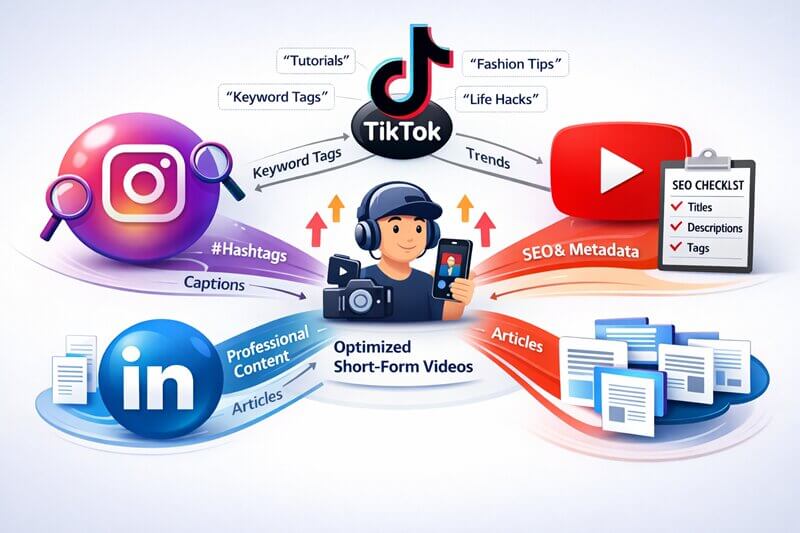
Each platform has its own search algorithm. Here’s how to optimize for the big ones.
TikTok SEO
TikTok’s search function is now a primary discovery tool, especially for Gen Z.
The most important thing you can do is hook with keywords in the first three seconds — say the search term out loud in your opening.
Put keywords in your caption naturally, because “Here’s how to meal prep for beginners” works better than clever wordplay. Use on-screen text that includes search terms since the algorithm reads it.
Add three to five relevant hashtags mixing broad tags like #cooking with specific ones like #mealprep2026. And always enable captions, because TikTok indexes every word spoken in your video.
For example, a video titled “5 TikTok growth hacks that actually work” with those exact words spoken in the hook, written on-screen, and included in the caption will rank for “TikTok growth hacks.”
Instagram SEO
Instagram search has evolved beyond hashtags into a sophisticated discovery engine.
Start by optimizing your profile with keywords in your name field (not just username). “Sarah | Social Media Tips” beats “Sarah Johnson” because the name field is searchable.
Write searchable captions with keywords in the first sentence, since Instagram indexes caption text.
Use alt text on every post. It’s not just for accessibility; it helps Instagram understand your content.
Create keyword-rich Reels with text overlays like “3 myths about Instagram growth” to clearly signal topic relevance. And leverage carousel posts with keyword-focused covers, as these rank well in search results.
Instagram prioritizes content from accounts that users engage with regularly. Consistency matters more than frequency.
YouTube SEO
YouTube remains the second-largest search engine globally. It’s also owned by Google, creating cross-platform SEO benefits.

Titles should include exact search phrases people use. For example, “How to edit videos for Instagram Reels” beats “My editing process.” Write detailed descriptions with keywords in the first 150 characters, and include timestamps and related terms.
Use tags strategically with five to ten relevant keywords, mixing broad and specific. Create custom thumbnails with readable text, including your keyword.
Add chapters with keyword-rich titles, as they appear directly in search results. And transcribe accurately, because YouTube indexes every spoken word.
Pro tip: Check YouTube’s autocomplete for keyword variations. If “Instagram Reels tips” autocompletes to “Instagram Reels tips 2026,” use the full phrase.
LinkedIn SEO
LinkedIn search focuses on professional content and thought leadership.
Profile optimization is foundational. Include keywords in your headline, about section, and experience descriptions.
Document carousels rank exceptionally well, so create PDFs with keyword-rich titles like “Complete Guide to B2B Content Marketing.”
Article headlines need keywords too; “5 LinkedIn strategies for founders” outperforms vague titles.
Comment strategically on relevant posts, since your comments are searchable and build authority. Use three to five relevant hashtags per post to categorize content.
LinkedIn rewards consistency and engagement. Post when your audience is active and respond to every comment.
Pinterest SEO
Pinterest functions as a visual search engine, making it perfect for evergreen content.
Pin descriptions need keywords in the first 50 characters. Board names should be searchable, e.g., “Social Media Templates” rather than “Stuff I Like.”
Use keyword-rich alt text on every pin. Create video pins with text overlays, including search terms, and link to valuable content that matches pin promises.
Pinterest users search with high purchase intent. Optimize for commercial keywords.
🎯 Social Media SEO Optimizer
Get platform-specific optimization tips for your content
Creating Search-Optimized Content
Knowing platform tactics is one thing. Creating content that ranks is another.
Content Formats That Rank
Certain formats consistently perform better in social search.
Problem-solving content tends to rank highest. Titles structured as “How to [solve specific problem],” “3 mistakes everyone makes with [topic],” or “Why your [thing] isn’t working (and how to fix it)” directly match what people type into search bars.
Listicles and compilations also perform well. Formats like “5 tools for [specific use case],” “Best [products/methods] for [audience],” and “Top [number] ways to [achieve result]” deliver clear, scannable value.
Comparison content rounds out the top performers. “Option A vs Option B: Which is better?”, “I tested [number] of [x thing] so you don’t have to,” and product reviews all satisfy the decision-making searches people commonly run on social platforms.
These formats work because they match search intent. People are looking for solutions, not entertainment.
The Hook-Value-CTA Framework
Every piece of social content needs three elements.
The hook fills your first three seconds. State your keyword and promise value: “Here’s how to grow on Instagram without buying followers.”
The value section is the middle of your content, where you deliver on your promise with specific, actionable information. You show, don’t just tell.
The CTA is your final moment, where you tell viewers what to do next: “Save this for later,” “Follow for more tips,” or “Link in bio for the full guide.”
This structure works across all platforms because it matches how people consume content while optimizing for search algorithms.
Keyword Research for Social Platforms
Don’t guess at keywords. Research them.
Start with platform autocomplete by typing your topic into each platform’s search bar and noting the suggestions.
Run competitor analysis by checking what keywords top creators in your niche use in titles and captions.
Use Google Trends to compare search volume for keyword variations, and try Answer the Public to find question-based keywords people are searching.
Finally, review your own platform analytics to see which past posts got discovered through search.
Focus on long-tail keywords with clear intent. “Instagram Reels tips for small businesses” beats “Instagram tips” because it’s specific and less competitive.
Measuring Social Media SEO Success
Key Metrics to Track
Your discovery metrics tell you whether your SEO efforts are working. Track profile visits from search, impressions from hashtags, content reached through search versus feed, and keyword ranking positions where applicable.
Engagement metrics reveal content quality. Pay special attention to save rate (the strongest signal of value), share rate (which indicates content worth spreading), comment rate (showing community engagement), and click-through rate to your profile or links.
Conversion metrics tie everything back to business results. Monitor followers gained from search traffic, website clicks from social profiles, lead generation from optimized content, and sales attributed to social search.
Most platforms provide these metrics in their native analytics. Check them weekly.
A/B Testing Your Optimization
Test one variable at a time. Compare keyword-first titles versus curiosity-driven titles. Test text overlay thumbnails versus clean images.
Try keyword-heavy caption openings versus story-driven ones. Compare broad versus niche hashtag sets. And find when your search traffic peaks by testing different posting times.
Give each test at least 10 posts before drawing conclusions. Algorithms need time to understand and distribute content.
Common Social Media SEO Mistakes to Avoid
Even experienced creators make these errors.
Keyword stuffing is the most obvious pitfall. Cramming keywords unnaturally into every sentence hurts readability and engagement, and algorithms detect this.
Ignoring platform differences is equally damaging. What works on TikTok won’t work on LinkedIn, so tailor your approach.
Chasing trends over relevance can also backfire; trending audio might get views, but if it’s not relevant to your keyword, it won’t build authority.
Neglecting profile optimization means leaving SEO goldmines untapped. Your bio, name field, and featured content all matter.
Posting without captions is a missed opportunity, because even if you speak your keywords, not everyone watches with sound.
Inconsistent branding confuses both algorithms and audiences when you use different keywords and messaging across platforms.
And forgetting engagement undermines everything else, because SEO isn’t just about keywords. Engagement signals matter enormously.
Conclusion
Social media SEO isn’t optional anymore. It’s how your audience finds you.
The platforms where people spend their time have become the platforms where they search for information. If your content isn’t optimized, you’re invisible, no matter how good it is.
Start with these action steps:
- First, choose your primary platform based on where your audience searches.
- Second, audit your current content for keyword optimization opportunities.
- Third, implement platform-specific tactics from this guide.
- Fourth, create a consistent posting schedule you can maintain.
- Fifth, track your search metrics and adjust based on data.
Remember: social media SEO is a marathon, not a sprint. Consistent, optimized content builds authority over time. Start today, stay consistent, and watch your discoverability grow. The search landscape has shifted. Your strategy needs to shift with it.