Fashion ads aren’t what they used to be. Gone are the days when a glossy magazine spread or a billboard on Sunset Boulevard could move the needle for your brand.
Today, if you’re not creating thumb-stopping content for TikTok, Instagram, and Pinterest, you’re basically invisible.
And here’s the kicker: social media now influences a staggering 75% of fashion purchase decisions.
That means your fashion advertising strategy needs to be as dynamic, fast-paced, and visually stunning as the platforms where your customers spend their time.
Brands often struggle with fashion ads, pouring money into campaigns that look beautiful but convert poorly, or worse, never even get seen.
The truth?
Creating compelling fashion ads today requires a completely different playbook than even two years ago.
This guide breaks down everything you need to know about fashion ads: what makes them work, how to create them efficiently, what conversion rates you should expect, and how to leverage tools like QuickVid to produce professional content without the traditional time and budget constraints.
Key Takeaways
- Video dominates fashion advertising: Short-form video content on TikTok and Instagram drives the majority of fashion discovery and purchase decisions
- Personalization is non-negotiable: AI-powered targeting and hyper-personalized messaging based on user behavior significantly outperform generic campaigns
- Creator partnerships beat traditional ads: Authentic influencer content, especially from micro-influencers, generates higher engagement and conversion rates than brand-produced advertisements
- Speed matters more than perfection: The ability to create and test multiple ad variations quickly using automated short-form video creation tools gives you a competitive advantage
- Inclusivity and sustainability sell: Fashion ads featuring diverse representation and transparent sustainability messaging resonate with conscious consumers and build long-term brand loyalty
What Are Fashion Ads? (And Why They’re Different Now)
Fashion ads are promotional content designed to showcase clothing, accessories, footwear, or fashion brands to potential customers. But that textbook definition doesn’t capture what fashion advertising has become.
Modern fashion ads are immersive, interactive experiences. They’re the 15-second TikTok that make you pause mid-scroll because the outfit transition is so seamless.
They’re the Instagram Reel where a creator styles the same dress three different ways. They’re the Pinterest ad with AR try-on technology that lets you see exactly how those sunglasses look on your face before you buy.
Here’s what separates effective fashion ads from everything else:
- Immediate visual impact: You have less than 3 seconds to capture attention
- Aspirational yet attainable: The best fashion ads make viewers think “I could be that person”
- Social proof integration: Reviews, UGC, and influencer endorsements baked directly into the creative
- Seamless shopping experience: Direct links to purchase without leaving the platform
- Cultural relevance: Connection to current trends, movements, or conversations
The shift from traditional to digital fashion advertising isn’t just about platform—it’s about fundamentally different consumer behavior. Your audience doesn’t want to be sold to. They want to be inspired, entertained, and educated. The fashion ads that win do all three simultaneously.
The Current State of Fashion Advertising
Let’s talk about where fashion advertising actually happens now. Spoiler: it’s not where you think.
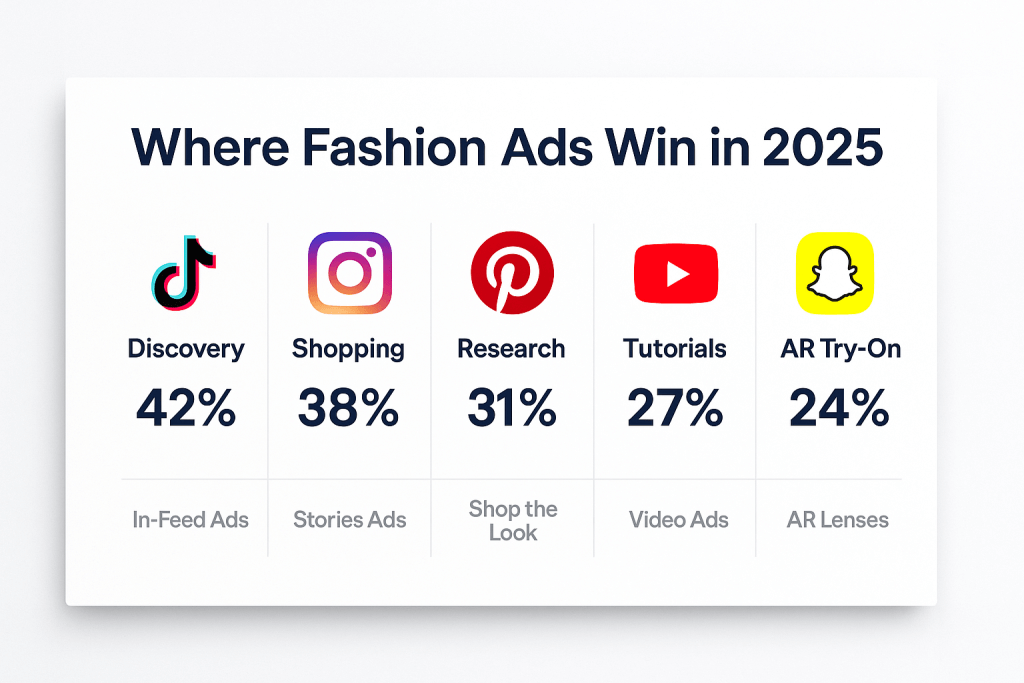
Platform Dominance Breakdown:
| Platform | Primary Use Case | Audience Behavior | Ad Format That Works |
| TikTok | Discovery & Trends | Active browsing, high engagement | Native-style creator content, challenges |
| Inspiration & Shopping | Visual exploration, story consumption | Reels, Stories with product tags | |
| Planning & Research | Intentional searching, saving | Rich Pins, video pins with tutorials | |
| YouTube Shorts | Entertainment & How-To | Quick consumption, tutorial seeking | Quick styling tips, outfit transitions |
| Snapchat | Exclusive Drops | Younger demographic, AR engagement | AR try-on lenses, limited-time offers |
Video content has taken over. Live shopping events, interactive videos, and creator-led storytelling aren’t just trendy.
They’re the primary way customers discover and evaluate fashion products. Brands that haven’t adapted to video-first advertising are losing market share to competitors who have.
The Rise of Shoppertainment
Shoppertainment is the fusion of shopping and entertainment. It represents the biggest shift in fashion advertising. Customers don’t just watch an ad and then navigate to your website.
They shop directly within the video, during a live stream, or through interactive elements embedded in the content itself.
This changes everything about how you need to think about fashion ads. Your creative isn’t just building awareness; it’s the entire purchase journey compressed into 30 seconds.
Hyper-Personalization Through AI
Generic fashion ads are dead. AI and machine learning now enable brands to deliver tailored product recommendations and messages based on landing page interactions, content engagement, and purchase history.
What does this look like in practice?
- A customer who browsed summer dresses sees ads for complementary accessories
- Someone who engaged with sustainable fashion content receives ads highlighting your eco-friendly production
- A visitor who abandoned their cart gets dynamic video ads featuring the exact items they left behind
The brands winning with fashion ads aren’t just creating one campaign. They’re creating hundreds of personalized variations that speak directly to individual customer segments.
How to Create Effective Fashion Ads That Convert
Creating fashion ads that drive real results isn’t about having the biggest budget or the fanciest equipment. It’s about understanding what makes people stop, watch, and take action.
The Hook Is Everything
You have 3 seconds. That’s it. If your fashion ad doesn’t grab attention immediately, it’s invisible.
Hooks that work:
- Visual disruption: Unexpected colors, patterns, or movements that break the scroll pattern
- Transformation moments: Before/after, outfit changes, styling reveals
- Relatable problems: “When you have nothing to wear but a full closet…”
- Bold statements: Text overlays with controversial or intriguing claims
- Human connection: Eye contact, genuine emotion, authentic reactions
The brands winning with fashion ads understand that the first frame determines everything. They test dozens of opening shots to find what interests their specific audience.
The Three-Act Structure for Short-Form Fashion Ads
Even a 15-second ad needs structure. Here’s the formula that consistently converts:
Act 1 (Seconds 1-3): The Hook
Grab attention with visual impact or a relatable problem. The hook is what determines if people stop and watch or keep scrolling.
Act 2 (Seconds 4-10): The Value
Show the product in action, demonstrate benefits, create desire
Act 3 (Seconds 11-15): The Call-to-Action
Clear next step with urgency or incentive. This is a specific action that you’d like them to take.
This isn’t revolutionary, but most fashion brands skip straight to showing their product without earning the viewer’s attention first. Don’t make that mistake.
Authenticity Beats Production Value
Here’s something that surprises traditional marketers: polished, high-production fashion ads often underperform compared to authentic, creator-style content.
Why?
Because social media users have developed an immunity to “ads that look like ads.” When content feels too produced, too perfect, too scripted, people scroll past it.
But when it looks like something their friend might post? They engage.
This doesn’t mean your fashion ads should look amateur. It means they should feel native to the platform.
A TikTok fashion ad should look like a TikTok video that happens to feature your product, not a TV commercial compressed into vertical format.
The Power of User-Generated Content (UGC)
UGC campaigns encourage customers to create and share branded content, providing authentic social proof that outperforms traditional brand-generated advertisements.
Why UGC works for fashion ads:
- Trust factor: 79% of people say user-generated content highly impacts their purchasing decisions
- Volume: One campaign can generate hundreds of unique ad assets
- Diversity: Real customers showcase products on different body types, styles, and contexts
- Cost-effectiveness: Lower production costs with higher authenticity
Smart fashion brands build UGC into their advertising strategy from day one. They create hashtag challenges, offer incentives for customer content, and systematically repurpose the best submissions into paid ads.
Fashion Ads: Best Practices for Different Platforms
Each social platform has its own culture, format requirements, and user expectations. Your fashion ads need to adapt.
TikTok Fashion Ads
TikTok is where fashion trends are born and where discovery happens. Your ads need to feel like native content.
What works:
- Trend participation: Jump on trending sounds, effects, and formats
- Creator partnerships: Collaborate with fashion creators who understand the platform
- Educational content: “How to style,” “5 ways to wear,” “Fashion hacks”
- Behind-the-scenes: Show your design process, factory tours, sustainability efforts
- Challenges: Create branded hashtag challenges that encourage participation
Format specs:
- Vertical video (9:16 ratio)
- 15-60 seconds (sweet spot is 21-34 seconds)
- Captions are crucial (80% watch without sound initially)
- Hook in the first 2-3 seconds
Tools like QuickVid make it incredibly easy to create TikTok-native fashion ads at scale. Instead of spending days on a single video, you can test multiple concepts, hooks, and formats to find what resonates with your audience.
Instagram Fashion Ads
Instagram remains the visual showcase for fashion. Reels dominate discovery, but Stories and Feed posts still drive conversions.
What works:
- Reels with product tags: Seamless shopping integration
- Story ads with swipe-up: Direct path to product pages and you can experiment with collages
- Carousel ads: Show multiple products or styling options
- Influencer takeovers: Let creators showcase your products authentically
- AR filters: Try-on experiences that drive engagement
Format specs:
- Reels: 9:16 vertical, up to 90 seconds
- Stories: 9:16 vertical, 15 seconds per frame
- Feed: Square (1:1) or vertical (4:5)
- High-quality visuals are non-negotiable
Pinterest Fashion Ads
Pinterest users are planners. They’re actively searching for inspiration and solutions, making them highly valuable for fashion advertisers.
What works:
- Idea Pins: Multi-page storytelling with outfit inspiration
- Video Pins: Quick styling tutorials and product showcases
- Rich Pins: Automatic product information updates
- Seasonal content: Plan 45-60 days ahead for seasonal fashion
- How-to content: “How to wear,” “How to style,” “How to choose”
Format specs:
- Vertical images (2:3 ratio, 1000x1500px)
- Video Pins: Square or vertical, 6-15 seconds ideal
- Clear, readable text overlays
- Bright, high-contrast visuals
Creating Fashion Ads Faster: The QuickVid Advantage
Here’s the reality: most fashion brands can’t keep up with the content demands of modern advertising. You need fresh creative constantly. Multiple variations. Platform-specific formats. Personalized versions for different audiences.
Traditional video production can’t scale to meet these demands. Hiring a production team for every ad variation is cost-prohibitive. Doing it all in-house is time-consuming and requires specialized skills.
This is where automated short-form video creation becomes important.
How QuickVid transforms fashion ad creation:
✅ Speed: Create professional fashion ads in minutes instead of days
✅ Volume: Test multiple concepts, hooks, and formats simultaneously
✅ Consistency: Maintain brand quality across all variations
✅ Platform optimization: Automatically format for TikTok, Instagram, YouTube Shorts
✅ No expertise required: Create professional content without video editing skills
The brands winning with fashion ads aren’t necessarily the ones with the biggest budgets. They’re the ones who can test and iterate faster than their competitors.
When you can create 20 ad variations in the time it used to take to produce one, you dramatically increase your chances of finding what works.
Fashion Ad Examples That Drive Results
Let’s break down real fashion ad approaches that consistently perform well.
Example 1: The Transformation Ad
Format: 15-second Instagram Reel
Hook: Person in casual outfit looking their closet, frustrated
Transition: Quick outfit change effect
Payoff: Styled in your product looking confident
CTA: “Shop the look” with product tag
Why it works: Relatable problem, satisfying transformation, clear product showcase, immediate shopping path.
Example 2: The Multi-Styling Ad
Format: 30-second TikTok
Hook: “3 ways to style this dress”
Content: Quick cuts showing same item styled casually, professionally, and for evening
CTA: “Which style is your favorite? Link in bio”
Why it works: Educational value, shows versatility, encourages engagement, demonstrates product value.
Example 3: The Social Proof Ad
Format: 20-second Story sequence
Hook: “What our customers are saying”
Content: Quick cuts of real customer photos and testimonials
Payoff: Product showcase with 4+ star rating
CTA: “Swipe up to shop”
Why it works: Builds trust through social proof, shows real people wearing products, creates FOMO.
Example 4: The Behind-the-Scenes Ad
Format: 45-second YouTube Short
Hook: “How we make our sustainable denim”
Content: Factory tour showing ethical production, sustainable materials
Payoff: Finished product showcase
CTA: “Shop conscious fashion”
Why it works: Transparency builds trust, appeals to values-driven consumers, differentiates from competitors.
Example 5: The Influencer Partnership Ad
Format: 25-second TikTok
Hook: Trusted micro-influencer in their natural environment
Content: Authentic product integration into their daily routine
Payoff: Genuine recommendation with discount code
CTA: “Use code STYLE20 for 20% off”
Why it works: Leverages influencer’s existing trust, feels authentic not advertorial, provides incentive.
Fashion Ad Conversion Rates: What to Expect
Understanding benchmark conversion rates helps you evaluate performance and set realistic goals.
Industry Average Conversion Rates for Fashion Ads:
- Click-Through Rate (CTR): 1.2-2.5%
- Landing Page Conversion: 2.5-4.8%
- Overall Conversion Rate: 0.03-0.12%
- Return on Ad Spend (ROAS): 3:1 to 6:1 (good), 6:1+ (excellent)
These numbers vary significantly based on factors like:
- Product price point: Lower-priced items typically convert higher
- Brand recognition: Established brands see better conversion rates
- Ad quality: Better creative directly impacts performance
- Targeting precision: Hyper-personalized ads outperform generic campaigns
- Offer strength: Discounts and limited-time offers boost conversion
What “good” looks like:
If you’re achieving a 2% CTR and 3% landing page conversion, you’re performing at or above industry average. If your ROAS is above 4:1, you’re doing well.
Anything above 6:1 ROAS is excellent and it may be time to scale your ad campaigns. As you scale, your ROAS will drop but as long as you maintain it at around 3:1 or above, you’re still in good territory.
Improving Your Fashion Ad Conversion Rates
Strategies that move the needle:
🎯 Better targeting: Use lookalike audiences, retargeting, and interest-based segments
📱 Mobile optimization: 80%+ of fashion purchases happen on mobile
⚡ Faster load times: Every second of delay costs you conversions
🎁 Stronger offers: First-time customer discounts, free shipping, bundle deals
📊 A/B testing: Test everything. That includes hooks, CTAs, formats, messaging
🔄 Retargeting sequences: Don’t give up after one impression
✨ Social proof: Reviews, ratings, UGC in your ads
The brands with the best conversion rates aren’t lucky. They’re systematically testing and optimizing every element of their fashion ads.
Creator Partnerships and Influencer Marketing for Fashion Ads
Creator partnerships and influencer marketing drive authentic engagement, with niche micro-influencers often outperforming celebrity endorsers in generating real sales and brand credibility.
Why Micro-Influencers Win
Macro-influencers (100K+ followers):
- Broader reach
- Higher costs (,000-,000+ per post)
- Lower engagement rates (1-3%)
- Less personal connection with audience
Micro-influencers (10K-100K followers):
- Niche audiences
- More affordable (0-,000 per post)
- Higher engagement rates (5-10%)
- Stronger audience trust and authenticity
For most fashion brands, especially those with limited budgets, partnering with 10 micro-influencers delivers better results than one macro-influencer at the same total cost.
Finding the Right Fashion Creators
What to look for:
✅ Audience alignment: Their followers match your target customer
✅ Authentic style: Their aesthetic complements your brand
✅ Engagement quality: Comments are genuine, not bot-driven
✅ Content quality: Professional-looking content that converts
✅ Brand compatibility: They’ve successfully promoted similar products
✅ Posting consistency: Regular content creation, not sporadic
Where to find them:
- Instagram and TikTok hashtag searches (#fashionblogger, #styleblogger, #ootd)
- Your own followers and customers
- Competitor brand partnerships (non-exclusive creators)
Note: There are influencer marketplaces but, more often than not, you’ll end up with inflated prices.
Structuring Creator Partnerships
Partnership models that work:
- Flat fee per post: Simple, predictable, one-time payment
- Commission-based: Percentage of sales driven (typically 10-20%)
- Hybrid model: Small flat fee + commission for performance incentive
- Product gifting: Free products in exchange for content (works for micro-influencers)
- Long-term ambassadorships: Ongoing relationship with monthly deliverables
Always provide creators with creative freedom within your brand guidelines. The most authentic (and effective) content comes when creators can showcase your products in their own style.
AI and Automation in Fashion Ad Creation
AI-generated content for fashion advertisements automates product descriptions, visuals, and campaign materials while maintaining coherence and brand consistency at scale.
How AI Is Changing Fashion Advertising
🤖 Content generation: Automated video creation, image editing, copywriting
🎯 Personalization: Dynamic ad variations based on user data
📊 Performance prediction: AI forecasts which creative will perform best
🎨 Image enhancement: Automated background removal, color correction, styling
📝 Copy optimization: AI-generated product descriptions and ad copy
🔄 A/B testing: Automated testing of multiple creative variations
👥 Audience insights: AI-powered analysis of customer preferences and behavior
The AI tools available today make it possible for small fashion brands to compete with major retailers in content volume and quality.
The QuickVid Approach to AI-Powered Fashion Ads
Traditional fashion ad creation involves multiple steps: concept development, shooting, editing, formatting, and distribution. Each step takes time and requires specialized skills.
QuickVid streamlines this entire process through intelligent automation:
- Input your product information and brand assets
- AI generates multiple video concepts and variations
- Customize with your specific branding and messaging
- Export in platform-optimized formats
- Deploy across TikTok, Instagram, YouTube Shorts, and more
This doesn’t replace human creativity. It amplifies it. You focus on strategy and brand vision while AI handles the technical execution.
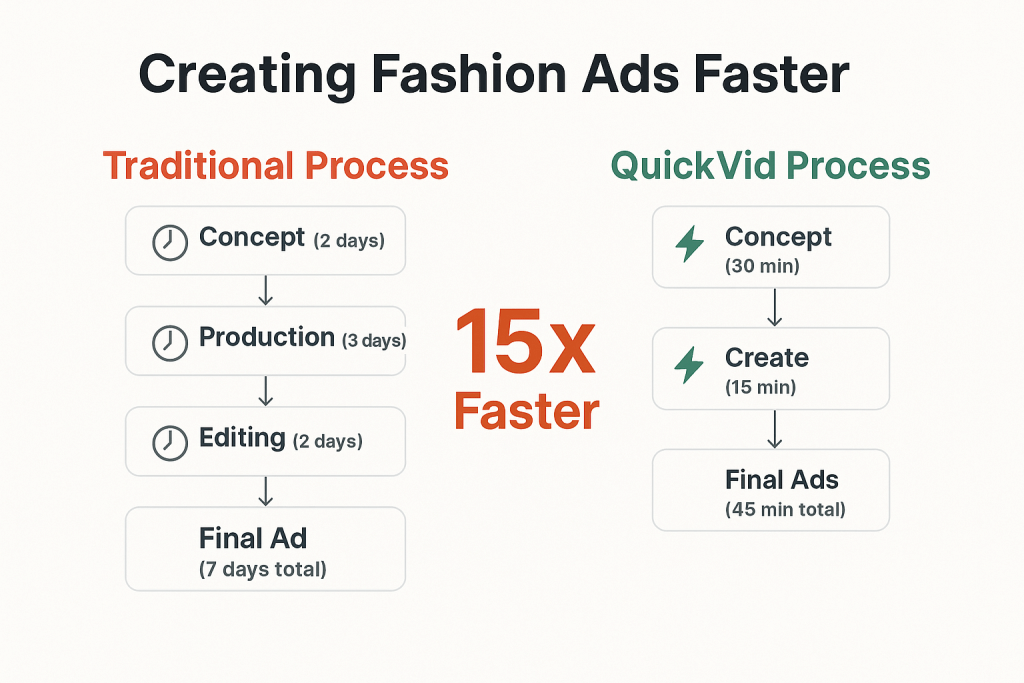
The result? Fashion brands can now test 20 different ad concepts in a week instead of spending a month producing one perfect ad that might not even resonate with their audience.
Measuring Fashion Ad Performance: Metrics That Matter
You can’t improve what you don’t measure. Here are the KPIs to pay attention to.
Awareness Metrics
Impressions: Total number of times your ad was displayed
Reach: Unique users who saw your ad
Brand lift: Increase in brand awareness from ad exposure
View-through rate: Percentage who watched your video ad completely
Engagement Metrics
Click-through rate (CTR): Percentage who clicked your ad
Engagement rate: Likes, comments, shares, saves
Video completion rate: Percentage who watched to the end
Time spent: Average time users engaged with your content
Conversion Metrics
Conversion rate: Percentage who completed the desired action
Cost per acquisition (CPA): How much you spent to acquire each customer (arguably the most important metric for paid ads)
Return on ad spend (ROAS): Revenue generated per dollar spent
Customer lifetime value (CLV): Long-term value of acquired customers
The Metrics That Predict Success
While vanity metrics like impressions and likes feel good, focus on metrics that directly tie to business outcomes:
🎯 ROAS: Your north star metric for profitability
💰 CPA: How efficiently you’re acquiring customers
🔄 Repeat purchase rate: Are ad-acquired customers coming back?
📈 Incremental revenue: Sales directly attributable to ads
Track these metrics across different ad variations, platforms, and audience segments to identify what’s working and double down on it.
💰 Fashion Ad Performance Calculator
Calculate your ad metrics and get personalized recommendations
Total amount spent on this campaign
Total number of times your ad was shown
Number of clicks on your ad
Number of purchases or desired actions
Total revenue from this campaign
Your Fashion Ad Performance
Common Fashion Ad Mistakes to Avoid
❌ Mistake 1: Prioritizing Aesthetics Over Performance
Your ad can be visually stunning and still fail completely. Beautiful doesn’t always equal effective. Test for performance, not just visual appeal.
❌ Mistake 2: Ignoring Platform-Specific Best Practices
A fashion ad optimized for Instagram won’t work on TikTok. Each platform has its own culture, format requirements, and user expectations. Adapt your content accordingly.
❌ Mistake 3: Weak or Missing CTAs
“Link in bio” isn’t compelling. Tell people exactly what to do and why they should do it now. “Shop now and get 20% off—today only” outperforms vague suggestions.
❌ Mistake 4: Not Testing Enough Variations
Running one ad creative and hoping it works is gambling, not marketing. Create multiple variations and let data tell you what resonates.
❌ Mistake 5: Neglecting Retargeting
Most people don’t buy on first exposure. Build retargeting sequences that nurture interest over time with varied messaging.
❌ Mistake 6: Inconsistent Brand Experience
Your ad promises one thing, but your landing page delivers something different. Ensure seamless brand consistency from ad to checkout. This is the basics of message match. Your ad should mirror the landing page.
❌ Mistake 7: Forgetting About Sound-Off Viewing
85% of social media videos are watched without sound initially. If your ad requires audio to make sense, you’ve lost most of your audience. Be sure to ad captions. QuickVid easily allows you to accomplish this.
Conclusion: Creating Fashion Ads That Win
Fashion advertising has fundamentally changed. The brands winning today aren’t necessarily the ones with the biggest budgets or the most established names.
They’re the ones who understand modern consumer behavior and can create compelling content at scale.
The good news?
You don’t need a massive budget or a full production team to create effective fashion ads anymore. Tools like QuickVid democratize content creation, allowing small brands to compete with major retailers in content volume and quality.
Your next steps:
- Audit your current fashion advertising strategy against the principles in this guide
- Identify your biggest gaps in content creation, personalization, or platform optimization
- Start testing new ad concepts and formats on your primary platforms
- Leverage automation tools to increase your content output without increasing your workload
- Measure everything and double down on what drives real business results
The fashion brands that thrive in 2025 and beyond won’t be the ones creating perfect ads—they’ll be the ones creating, testing, and optimizing faster than their competitors. Start today, iterate constantly, and let data guide your decisions. Ready to transform your fashion advertising? Explore QuickVid and start creating scroll-stopping fashion ads in minutes instead of days